

Does My Relationship Hold All of My Blackness — A Call Back
On Afro-Latina identity, insulation, and the material realities behind romantic choice.

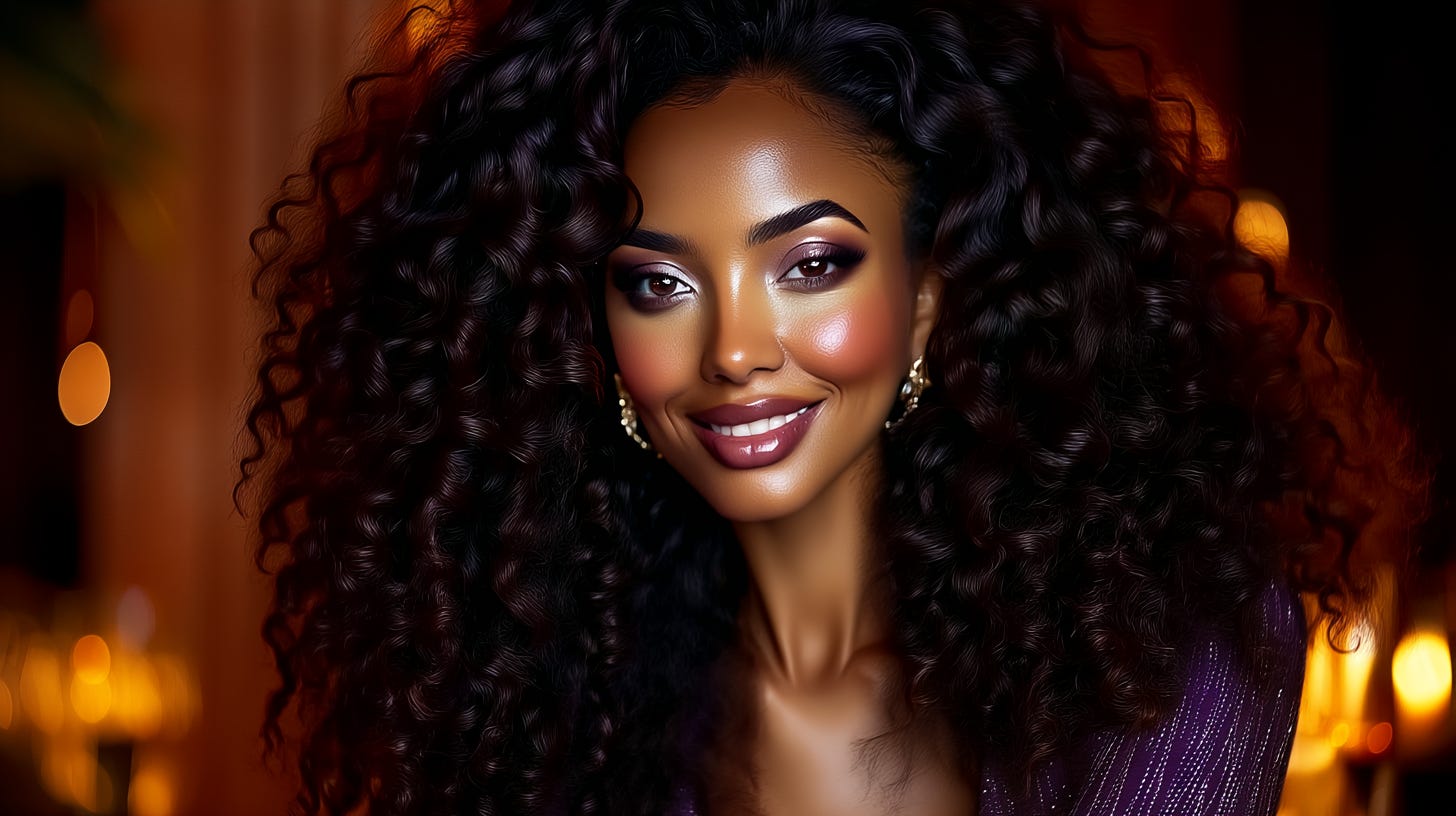
A response to Michelle O’Drama, who asked the question most people avoid.
She is a woman after my own heart.
Not because I agree with every conclusion she reaches, but because she asks the questions most people are afraid to sit with long enough to be changed by them.
The questions she asks are deep. Complex. And if I’m honest, they leave me feeling a little exposed—because they press exactly where the fault lines already exist. Especially this one:
Is the love you want big enough to hold your entire Black identity? Or would you have to shrink to fit inside it?
That question deserves a real answer. Not a slogan. Not a defense. Not a performance of loyalty.
So here’s mine.
I come to this conversation as an Afro-Latina. Which means I come from a lineage where Blackness has never existed in isolation.
For every Black person in my family, there is a white one. And an Indigenous one. And often all three living under the same roof, sharing the same last name, arguing over the same table.
To people unfamiliar with Latin American history, that can look like contradiction. Or dilution. Or confusion.
But it isn’t.
It is colonialism. It is colorism. It is racism—yes—but racism that competes viciously with every other “ism” at the same time.
Classism. Feminism. Masculinism. A very specific, very old form of Spanish racism shaped by empire, Catholicism, and caste.
Add to that the long history of Black—especially North African—intermixing across the Spanish-speaking world, and you get something different from the Black American experience.
Not easier. Not cleaner. Just… different.
There has always been a kind of permeability around race in my world—especially for women who are beautiful, educated, and come from families with social standing.
I dated men of many races without anyone batting an eye. Not because racism didn’t exist—but because beauty, pedigree, and proximity to power softened its teeth.
That’s an uncomfortable truth. But it’s still the truth.
My long-term partner comes from a different part of the world entirely. He is not white. I am not white.
And yet race—like money, like gender roles, like ambition—became another item in the long list of adult negotiations that real relationships require.
So let me answer the question plainly:
Does my relationship allow for all of my Blackness?
Yes. It does.
But not for the reason people like to romanticize.
It allows for my Blackness because he has enough resources—financial, social, cultural—to give zero fucks about defending himself against proximity to it.
And I have enough other attributes—beauty, education, charm, status—that my Blackness is not the first thing he has to negotiate with the world.
That is not a moral victory. It is a material reality.
And it forces a harder question underneath the one she asked:
If I were not Latina— If I were not read as “exotic” in a way that is both a burden and a benefit— If I came from another part of the diaspora without that particular ambiguity— Where would I be?
Where would my Blackness land?
Would it still be held so easily?
Or would it suddenly feel like something to manage, soften, explain, or survive?
I honestly don’t know.
And that uncertainty is precisely why her question matters.
Because Black love in America is not just about romance. It is about safety. It is about rest. It is about whether you are allowed to exist fully—or only conditionally.
Some of us are loved without shrinking because we bring enough insulation with us to absorb the impact.
Others are asked—explicitly or not—to make themselves smaller so the relationship can function.
And that difference is not about individual virtue. It is about history. Power. And which forms of Blackness the world has decided are tolerable.
So when people react to Venus. To Serena. To icons raised on Black resistance choosing partners outside the race—They are not reacting to whiteness.
They are reacting to a fear older than the internet:
If even women raised on Black pride, Black protection, and Black legacy did not find safety inside Black love… what does that mean for the rest of us?
That fear isn’t irrational. It’s inherited.
And answering it requires more honesty than slogans about “love is love” will ever provide. Because love that fractures you is not love.
But neither is love that only works because you are insulated from the cost of being fully seen.
And that tension—right there—is where the real conversation begins.
This was so dope and insightful to read. I read it a few times before commenting . Thank you for your response - and that realism about how you probably wouldn’t have been as easily accepted If you didn’t “look exotic” or Latina more than you do Afro lol - is a lane I didn’t even think of. Excellent self reflection and head on confrontation with truth. Thank you for going on that journey and sharing it